
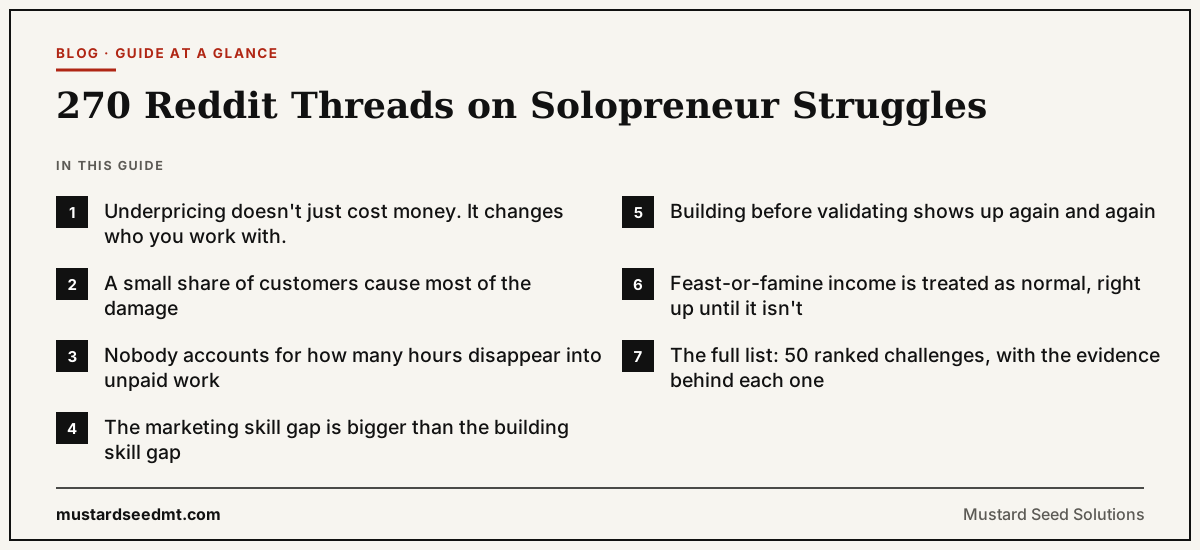
We read 270 threads from r/Solopreneur and r/smallbusiness — real posts from real business owners, not survey responses — and sorted every recurring complaint into categories. The clearest pattern: getting customers and pricing correctly cause more damage than the operational problems most business advice focuses on.
The methodology is simple and we're not going to oversell it. We pulled 270 threads: 73 from r/Solopreneur and 197 from r/smallbusiness, spanning several years of posts. We read each thread in full along with its top comments, then grouped the recurring pain points by how often they showed up and how much frustration they carried. This is not a scientific survey with a controlled sample — it's a close read of what solopreneurs and small business owners actually vent about, warn each other about, and learn the hard way. From that read, we built a ranked list of 50 challenges, which we're publishing in full as an interactive report.
A handful of findings surprised us enough that we're leading with them here. The rest — all 50, ranked, each with the evidence behind it — live in the full report.
Underpricing doesn't just cost money. It changes who you work with.
One of the most upvoted posts in the entire dataset was a single blunt argument on r/smallbusiness: undercutting your own prices doesn't win you more customers, it just changes who shows up — for the worse. Nearly 180 replies piled on with versions of the same story across completely different industries. Commenters described how discount-seeking customers contested every price, sent the most revision requests, and paid the slowest.
The pattern repeated with specifics. A performance design studio owner described giving a client a steep one-time discount during a health crisis, then quoting a standard rate for a much bigger follow-up project months later — and losing both that client and the referring client who'd sent her, over an amount several commenters pointed out was still underpriced for the work involved. A digital marketing freelancer told a more deliberate version: after three years of undercharging, a 40% rate increase pushed out 30% of the client list, and monthly revenue still rose, because the clients who left were the ones who haggled hardest and demanded the most revisions.
This is the exact mechanic behind our pricing guide — and it's worth running your own numbers through the freelance rate calculator before you assume your current rate is fine just because clients keep paying it.
A small share of customers cause most of the damage
A closely related pattern showed up in a widely discussed r/smallbusiness thread arguing that a tiny minority of customers — the poster estimated somewhere around 2 to 3 percent — generate a wildly disproportionate share of the stress in running a small business. Replies described managing this with blunt tools: firing the worst offenders outright, or simply accepting that difficult customers who fixate purely on price rather than value are, as one commenter put it, always going to be the worst ones to deal with. We go deeper on spotting these patterns early in our guide to difficult clients.
Nobody accounts for how many hours disappear into unpaid work
A recurring thread involved founders who assumed their revenue was healthy until they actually logged their hours. The freelancer above, doing the math on hours, software costs, and taxes after three years without giving themselves a raise, found their effective pay worked out to roughly $14 an hour — under minimum wage in most of the country, for work that required real expertise. A separate solo founder described feeling like they worked 16-hour days without making visible progress, unable to say where the time actually went, and suspecting email alone was swallowing a disproportionate share of it.
Revenue and take-home pay are not the same number once every non-billable hour — admin, invoicing, revisions, marketing, unpaid discovery calls — gets counted. We go deep on this exact math in our true hourly rate piece, with a calculator that runs the numbers for you.
The marketing skill gap is bigger than the building skill gap
Across dozens of threads, the same builder described the same wall: a genuinely finished product, and no idea how to get it in front of a single paying customer. One poster listed off more than a dozen tools they'd built and shelved — an astrology app, a restaurant management tool, a document search system, an accounting tool, a mock-interview platform — and summarized the whole pattern in one line: they could ship literally anything, but couldn't sell to save their life.
Another thread that circulated widely made the same point from the opposite direction. Someone who'd studied a group of solo founders clearing five figures a month found that none of them had a unique idea — what they had in common was picking a specific, reachable audience before they picked what to build, charging money before the product was even finished, and spending roughly half their working time on distribution rather than product. The single highest-voted reply to that post read simply: distribution is the whole game, everything else is easy.
A third thread made the cost of skipping this concrete. Someone described two years of building full applications solo with AI-assisted "vibe coding" after leaving their job — six or seven shipped projects, each one met with total silence, or at best a brief spike in visitors after a single Reddit post that faded within 48 hours. Not one produced a paying customer. The top reply agreed the technical barrier really was gone, but pointed out that this was now true for everyone simultaneously — which made the competition for attention sharper, not easier.
We break this pattern down in full in the distribution trap, and it's the reason our marketing pillar guide exists.
Building before validating shows up again and again
A separate, heavily upvoted post came from a founder who'd bootstrapped an education company to seven figures but had also burned money on several failed attempts at other business models. Their diagnosis of the failures was consistent: they'd built first and asked whether anyone wanted it second, rather than the other way around. Their proposed fix — talk to real potential customers and test willingness to pay before writing a line of code or ordering inventory — is a theme that recurs constantly across both subreddits, usually learned only after the expensive version of the lesson. We cover this in our guide to validating a business idea before you build.
Feast-or-famine income is treated as normal, right up until it isn't
A steady undercurrent across r/smallbusiness threads was how unprepared people felt for how unstable solo income actually is. One owner, about a year into running a small local service business, described the real surprise not being the workload but the swing between invoicing five clients in a good week and refreshing their inbox anxiously the next. The advice that showed up repeatedly in replies was blunt: build a reserve of several months of expenses, because the income itself will never behave like a paycheck, and judge the business by its trailing twelve-month average rather than any single strong or weak month. We cover the practical side of that in our cash flow management guide.
The full list: 50 ranked challenges, with the evidence behind each one
These four findings are the ones that surprised us most, but they're only a fraction of what showed up across 270 threads. We ranked all 50 recurring challenges by how often and how intensely they appeared, and built an interactive report where you can filter by category — marketing, clients, money, mental health, platform risk — and open each entry to see the actual evidence behind the ranking, plus a link to the guide or tool that addresses it. If any of the four problems above sounded familiar, there's a good chance several more on that list will too.